By Nick Coutu
Diamond Shapes: Finding the Right Outline
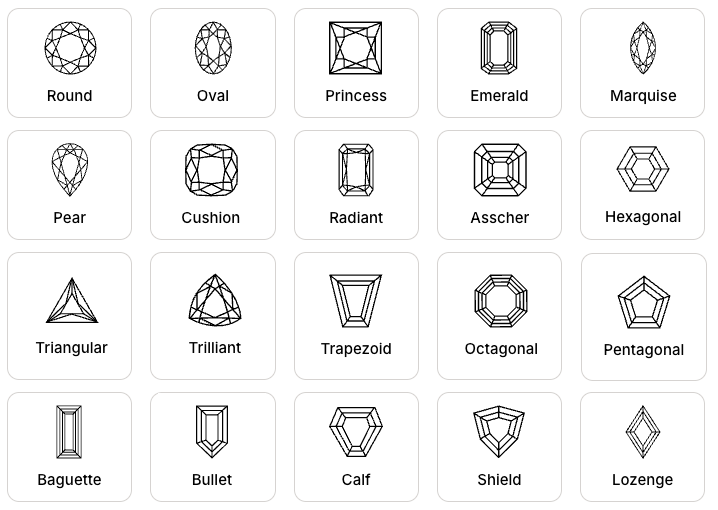
The shape of a diamond is one of the first things you notice. It helps set the ring’s character, but the outline is only part of what you are seeing.
Shape and Cut Are Different Decisions
Shape describes the outline seen from above. Cut style describes the arrangement of the facets, while cut quality concerns how well the stone has been proportioned and finished. Together, those choices affect light performance, apparent size and the way the stone sits in a ring.
- Light: facet arrangement and proportions influence brightness, fire and the pattern of flashes.
- Proportion: consider the diamond’s length and width alongside the band and setting.
- Association: a heart may carry an obvious meaning, while another outline may simply be the one you love.
The Main Shapes and Cut Styles
- Round brilliant. A circular outline with brilliant-style faceting. Its brightness still depends on the individual stone’s proportions and finish.
- Princess. Usually a square outline with pointed corners and brilliant-style faceting. The setting needs to protect those corners.
- Emerald cut. A rectangular outline with clipped corners and step facets that give broad, mirror-like reflections.
- Oval. An elongated, rounded outline, commonly cut in the brilliant style. Compare its proportions on the hand.
- Marquise. A long outline with two pointed ends. Its spread can look substantial for its weight, but depth and proportions still matter.
- Pear. A rounded end tapering to a point. Consider the direction you want to wear it and how the point will be protected.
- Radiant. A square or rectangular outline with clipped corners and a lively brilliant-style facet pattern.
- Asscher. A square, clipped-corner outline with step faceting. Look at its symmetry and the pattern visible through the table.
- Trillion or triangular. A three-sided outline, with straight or curved sides depending on the cut. It can make a distinctive centre or side stone.
Other Outlines Worth Considering
There are more choices than the familiar round, oval or emerald cut.
- Cushion: a square or rectangular outline with rounded corners. Facet patterns vary, so compare individual stones.
- Hexagon or kite: geometric outlines that can give a ring a distinctive structure. Availability and facet styles vary.
Unusual Shapes and Custom Design
An unusual outline can become the starting point for a custom ring. Bring us the idea so we can discuss what stones are available and what is feasible for the design.
Three Things to Compare
- Appearance: look at the stone in different lighting and compare its proportions.
- Wear: discuss how the setting will protect any points or exposed corners.
- Connection: choose an outline you enjoy looking at and can imagine wearing.
Shape is a strong starting point, but it does not make the whole decision. The right diamond and a well-considered setting need to work together.
To compare an outline within a finished design, explore our engagement ring settings and ask which centre stones suit the setting you like.