By Nick Coutu
Engagement Ring Styles
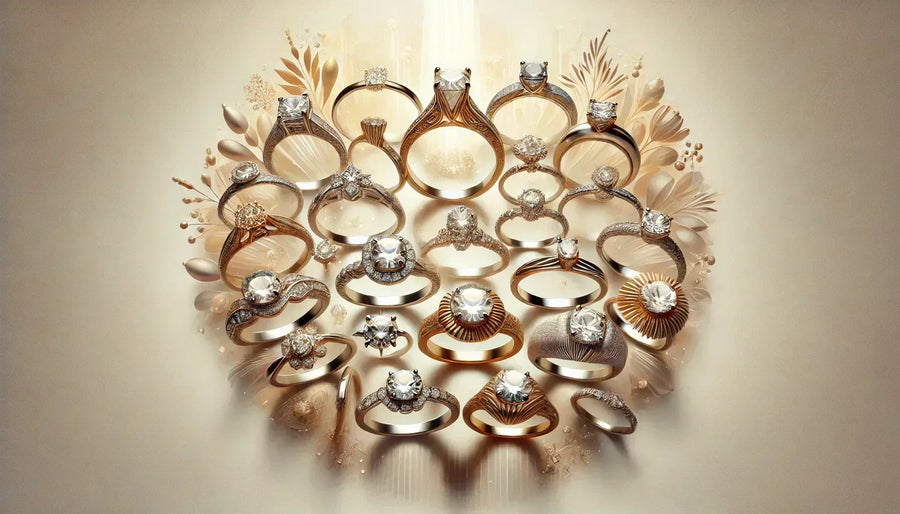
A style name gives you a useful place to begin discussing a ring. Some names describe the arrangement of stones, others the way a stone is held or a broader design influence. They can overlap: a solitaire can have a bezel, and a vintage-inspired ring can have a halo.
1. Solitaire
A solitaire places one main stone at the centre of the design. The stone can be held with prongs, a bezel or another suitable construction. Its appeal is the clear emphasis on the stone and the proportions around it.
2. Vintage-Inspired
For a newly made ring, “vintage-inspired” describes a design influence from an earlier period. Filigree, engraving and fine milgrain edges are some of the details you might choose. Art Deco influences often use geometric forms; Edwardian-inspired designs may use delicate garlands, ribbons and lace-like metalwork.
3. Contemporary
Contemporary design can be pared back, sculptural or richly detailed. Unusual settings, mixed metals and open space offer ways to explore proportion and form.
4. Art Nouveau-Inspired
The Art Nouveau movement is known for its flowing lines, organic motifs, and artistic flair. An interpretation might use flowing curves, floral forms or vines.
5. Halo
A halo is an outline of smaller stones around the centre stone. It adds a visual frame and can make the centre appear larger. The result depends on the spacing and proportions.
6. Hidden Halo
A hidden halo places small accent stones lower in the head, beneath the centre stone. The detail is best seen from the side.
7. Three-Stone
Three stones are often associated with past, present and future, though you can give them your own meaning. A larger centre with two smaller side stones is a familiar arrangement; equal sizes and contrasting shapes offer other possibilities.
8. Diamond-Set Band
Diamonds can extend partway or all the way around the band. Pavé and channel setting give different effects. Discuss the extent of the stones and the possibilities for future resizing.
9. Coloured Accents
Sapphire, ruby, emerald or coloured diamond can introduce contrast or a personal association. Use them beside the centre stone or as smaller details in the band; discuss the care needs of the chosen gem.
10. Nature-Inspired
Leaves, vines, petals and other natural forms can guide a ring’s outline. A motif can be literal or suggested through a curve, an engraved line or the placement of a stone.
11. Bypass
In a bypass design, the two sides of the band sweep past one another. They may frame one stone or more than one. You might use that movement to suggest two lives coming together.
12. Bezel
A bezel holds a stone with a rim of metal following its outline. A full bezel surrounds the edge; a partial bezel leaves sections exposed. Security depends on the quality and condition of the setting. A well-designed bezel may suit someone who wants a smooth outline with less exposed stone.
13. Side Stones
Side stones sit beside the centre stone and may be a different size, shape or colour. They can balance the centre or lead the eye into the band. This arrangement can be combined with a diamond-set shank.
14. Twist
A twist design uses strands or sections of metal that appear to wind around one another. The movement can suggest intertwining lives, if that association matters to you.
15. Pavé
Pavé means “paved” in French. Small stones sit closely together, held by tiny beads of metal. It creates a closely set field of sparkle; the small settings need care and periodic inspection.
16. Tapered Band
A band can narrow toward the centre stone, drawing attention to that transition. The amount of taper changes the balance of metal and stone. It still needs enough material to support the setting.
17. Channel Setting
Channel-set stones sit in a row between two metal walls, with no individual prongs rising between them. The continuous metal edges create a defined line along the band.
Bringing the Choices Together
At Lessard Coutu Jewellery, we can use these ideas as starting points for a custom design. We consider the person, the stone and the way the ring will be worn before deciding which details belong. Some ideas need to be adjusted for comfort, strength or budget. The aim is a ring whose parts make sense together and whose details feel right to the person wearing it.
To compare those decisions in actual designs, explore our engagement ring settings or view the collection.