By Nick Coutu
Ring Anatomy: The Details You Can Personalize
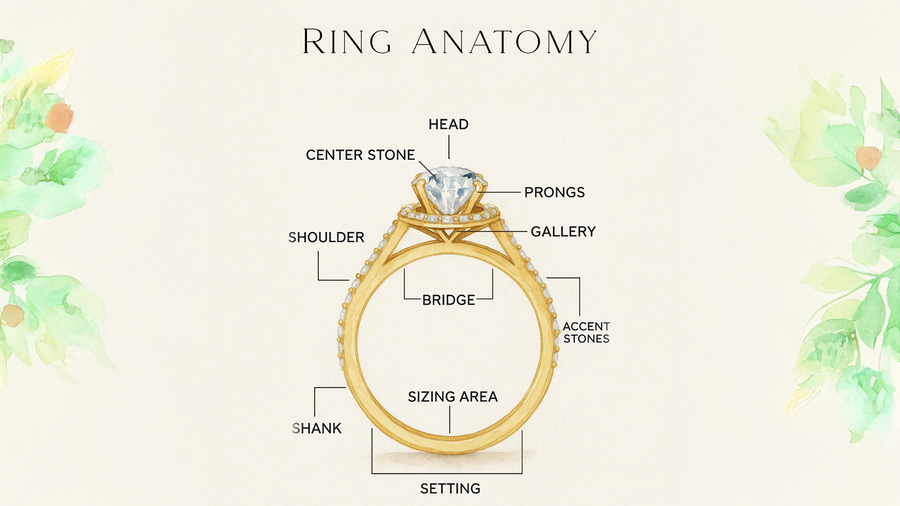
The centre stone draws your eye first, but the metal around it does much of the design work. The head, prongs, shoulders and band shape how a ring looks and how it wears. Knowing their names helps you explain what you want to change.
A personal detail can belong in plain sight or be tucked underneath the stone. The following areas give us room to work, within the needs of the stone, the structure and the person wearing it.
Head: Holding the Centre Stone
The head is the part of the ring that holds the centre stone. Its design can include scrollwork, filigree or a hidden halo, where the construction allows.
A basket head connects the prongs with supporting metal beneath the stone. Cathedral shoulders rise from the band toward the head. A solitaire describes a ring centred on one main stone; it can use either of those constructions. These terms overlap, and none alone tells you the ring’s height or durability.
Centre Stone: Shape, Colour and Character
The centre stone sets much of the ring’s proportion and character. Choose from diamonds, sapphires, moissanites, and more. For a diamond, compare cut, clarity, colour and carat weight, as well as shape. For other gemstones, ask about durability and care. Discuss sourcing information and the significance a particular stone or colour has for you.
Prongs: Small Details, Important Work
Prongs are the metal claws that secure a stone. Rounded, pointed or double prongs give different visual effects; their size and placement must suit the stone. A fine claw can look precise, while a rounded tip can soften the outline. Double prongs add detail; their strength depends on size, placement and workmanship.
Gallery: The View Beneath the Stone
The gallery gives the side view of a ring its character. This area beneath the centre stone may contain supporting metalwork, small gems or an inscription. Vines, waves, initials or a small hidden detail can live here. The design must still leave room to secure and care for the stone.
Shoulders: Connecting the Band and Head
The shoulders are the upper parts of the shank that meet the setting. They can carry pavé diamonds, engraving or clusters of stones. Tapered or split shoulders change the transition toward the centre.
Bridge: Structure Underneath
The bridge connects the sides of the shank beneath the setting, where the ring rests above the finger. Where there is room, it can also carry a discreet design detail. A pattern or small motif can continue from the gallery into this area, provided it does not compromise the construction.
Accent Stones: Shape and Movement
Small stones can change a ring’s outline, colour or rhythm. You might choose them for a personal association, such as a birthstone or a meaningful number. Different shapes, clusters and graduated sizes can lead the eye toward the centre stone or create movement along the band.
Shank: The Band Around the Finger
The shank is the part of the ring that encircles the finger. Its width, thickness and profile affect both appearance and comfort. A knife-edge profile has a raised outer ridge. A twisted or braided shank introduces movement; milgrain adds a fine beaded edge. These choices should work with the ring’s proportions and fit.
Metal, Texture and Finish
The metal and finish give the whole ring a consistent character. A polished surface, a matte finish or an engraved pattern can make the same outline feel quite different. Mixed metals and changes in width or thickness offer further possibilities. A delicate appearance still needs enough structure for its intended wear.
Sizing Area: Leave Room for Adjustment
We generally recommend leaving a plain area at the back of the shank for possible future sizing. Whether and how much a ring can be resized depends on its metal, construction and stone placement. Talk about that before adding stones or an intricate pattern all the way around the band.
Good custom design brings these parts into agreement. A detail can carry meaning, improve the silhouette or make the ring easier to wear. Give each one a reason to be there.
To see how these parts work together, explore our engagement ring settings and bring the details you would like to change to the design conversation.