By Nick Coutu
What If We Asked More of the Engagement Ring?
I think the person given the responsibility of making an engagement ring should take that responsibility seriously.
Because you're not just making jewellery.
You're being asked to represent a human connection.
Two people may carry this object through a marriage.
It may be there when they're newly engaged. At the wedding. On ordinary Tuesday mornings. Through homes and careers, perhaps children. Through difficult years and extraordinary ones.
And over time, it can become something more than the object that was originally made.
It can accumulate indications of commitment.
Every year it remains on that hand means something.
Every ordinary morning.
Every anniversary.
Every difficult season they decided to move through together.
Every time one of them looked across a room and thought, that's my person.
The ring begins as an object made by a jeweller.
Then the couple spends a lifetime making it theirs.
That is why I don't think an engagement-ring process can simply be:
Pick this diamond because the numbers on the grading report are good.
Pick this setting because it's popular.
Put the two together.
Done.
That's not enough.
If someone trusts me with an engagement ring, I want to understand what I'm actually being trusted with.
I want to know about the person who will wear it.
What he sees in her.
What they notice about each other.
How they met.
Where they feel most themselves.
What they have survived together.
What makes them laugh.
The places that belong to them.
The things they say to each other.
The things they no longer need to say.
And what their life feels like when everything else gets quiet.
Because somewhere inside those answers is design information.
Not necessarily literal information.
I'm not interested in turning every memory into a tiny engraved symbol.
Sometimes a relationship should influence a ring in a way that can't immediately be explained.
A curve might come from the feeling of a landscape.
Two forms might lean toward one another because that is how the couple seems to move through life.
A hidden detail might belong only to them.
A stone might simply have a character that reminds me of the person I've been hearing about.
Sometimes the most meaningful part of a ring is the thing almost nobody else will ever notice.
The goal isn't uniqueness.
The goal is recognition.
I want someone to see the finished ring and somehow feel:
Of course that's hers.
I'm crazy enough to believe that a truly meaningful engagement ring can help keep two people together
I'm crazy enough to believe that a truly meaningful engagement ring can help keep two people together.
Reminders matter.
A ring can't communicate for you.
It can't make you listen.
It can't repair something you've neglected.
It can't choose your partner again on a difficult day.
People do those things.
But people surround themselves with reminders of what matters.
Photographs.
Letters.
Songs.
Places.
Traditions.
Anniversary dinners.
The restaurant where they first met.
A bottle of wine saved for a particular occasion.
An old voicemail they can't bring themselves to delete.
Objects become attached to memories.
Memories become attached to people.
And an engagement ring has an unusual opportunity: for many people, it is a deeply symbolic object worn almost every day.
So I think we should ask more of it.
Not that it simply says:
I'm married.
But perhaps, quietly:
This is what we chose.
This is what I saw in you.
This is who we were when we began.
This is still us.
Maybe twenty years later, someone looks down at their hand and, for half a second, they're somewhere else.
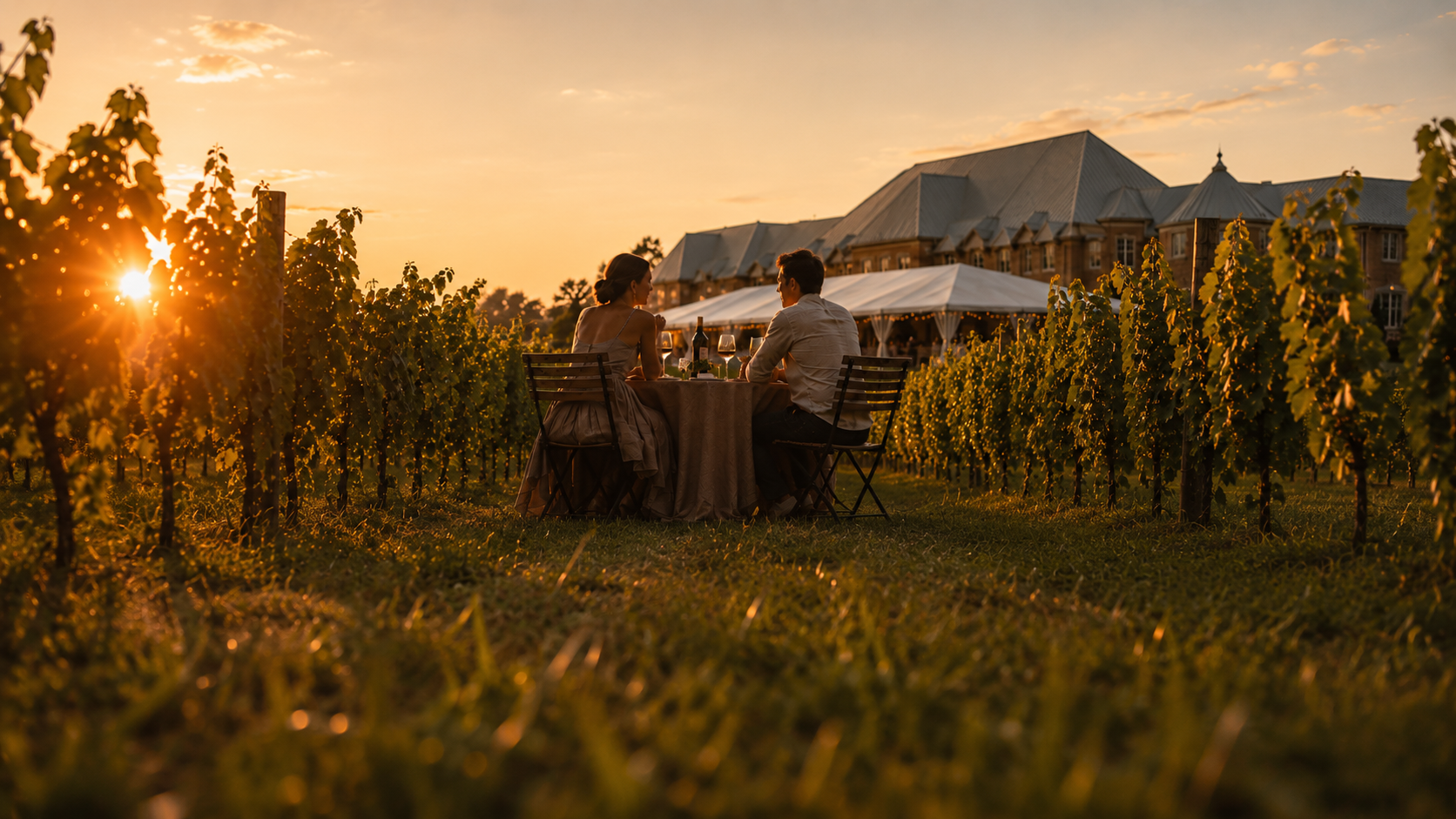
There is a table.
Two chairs.
A bottle of wine.
Golden hour moving across the vines.
A soft breeze.
Nothing particularly extraordinary is happening.
They're simply together.
And for a moment, the noise falls away.
They remember what that feels like.
Closeness.
Stillness.
Unity.
Love.
If a piece of jewellery can occasionally bring someone back there, I think that matters.
The responsibility of the designer
If an engagement ring is merely a luxury product, my responsibility is relatively straightforward.
Make it beautiful.
Make it well.
Choose the materials well.
All of those things matter.
But if the ring may eventually become an artefact of a relationship, the responsibility feels larger.
I'm being allowed into an unusually private moment in two people's lives.
Someone is sitting across from me describing the person they intend to marry.
Sometimes they know exactly what they want.
Often they don't.
And I don't think they should have to.
There can be an expectation that the person proposing suddenly needs to become a jewellery expert.
They start learning diamond terminology.
Settings.
Proportions.
Clarity grades.
Prong styles.
But none of those things tells me the most important thing.
Who is she?
You don't need to be an expert on diamonds.
You need to be an expert on the person you love.
My responsibility as the designer is to help turn that knowledge into a ring.
To listen carefully enough.
To notice what matters.
To ask better questions.
To understand what he sees in her.
And then to translate something intangible into something physical.
That is the part of jewellery design I find endlessly fascinating.
Taking something that has no shape—
a memory,
a promise,
a feeling,
a shared place,
a way two people understand one another—
and finding a form for it.
Meaning isn't finished when the ring is
There is something else I think designers need to understand.
We don't create the meaning.
We can listen.
We can interpret.
We can make an object worthy of receiving it.
But the couple does the rest.
The meaning of an engagement ring isn't complete when it leaves my bench.
That's when another part of its life begins.
The proposal adds something.
The wedding adds something.
The first anniversary adds something.
Ten years adds something.
Thirty adds something.
The scratches eventually add something.
The repair adds something.
The story about the time it was almost lost adds something.
And perhaps, one day, the person who inherits it adds something too.
The ring can become a reminder of the times two people kept showing up.
Its value eventually becomes almost impossible to describe using the language jewellery usually gives us.
Carat.
Colour.
Clarity.
Gold weight.
Market value.
Those things can describe the material object.
They cannot describe what the object eventually holds.
Begin with the relationship
So this is how I believe an engagement ring should begin.
Not with the diamond.
Not with the setting.
Not with the trend.
With the people.
Ask better questions.
Listen to the answers.
Pay attention to the tiny things.
What they notice about each other.
What he sees in her.
What their life feels like when everything else gets quiet.
Then draw.
Then find the stone.
Then make the ring.
And make it with the seriousness appropriate to what you've been entrusted with.
Because I believe an engagement ring can become more than a beautiful object marking the beginning of a marriage.
I think it has the potential to become one of the objects through which a relationship remembers itself.
And if we're lucky enough to make something that will sit on someone's hand for the next fifty years—